
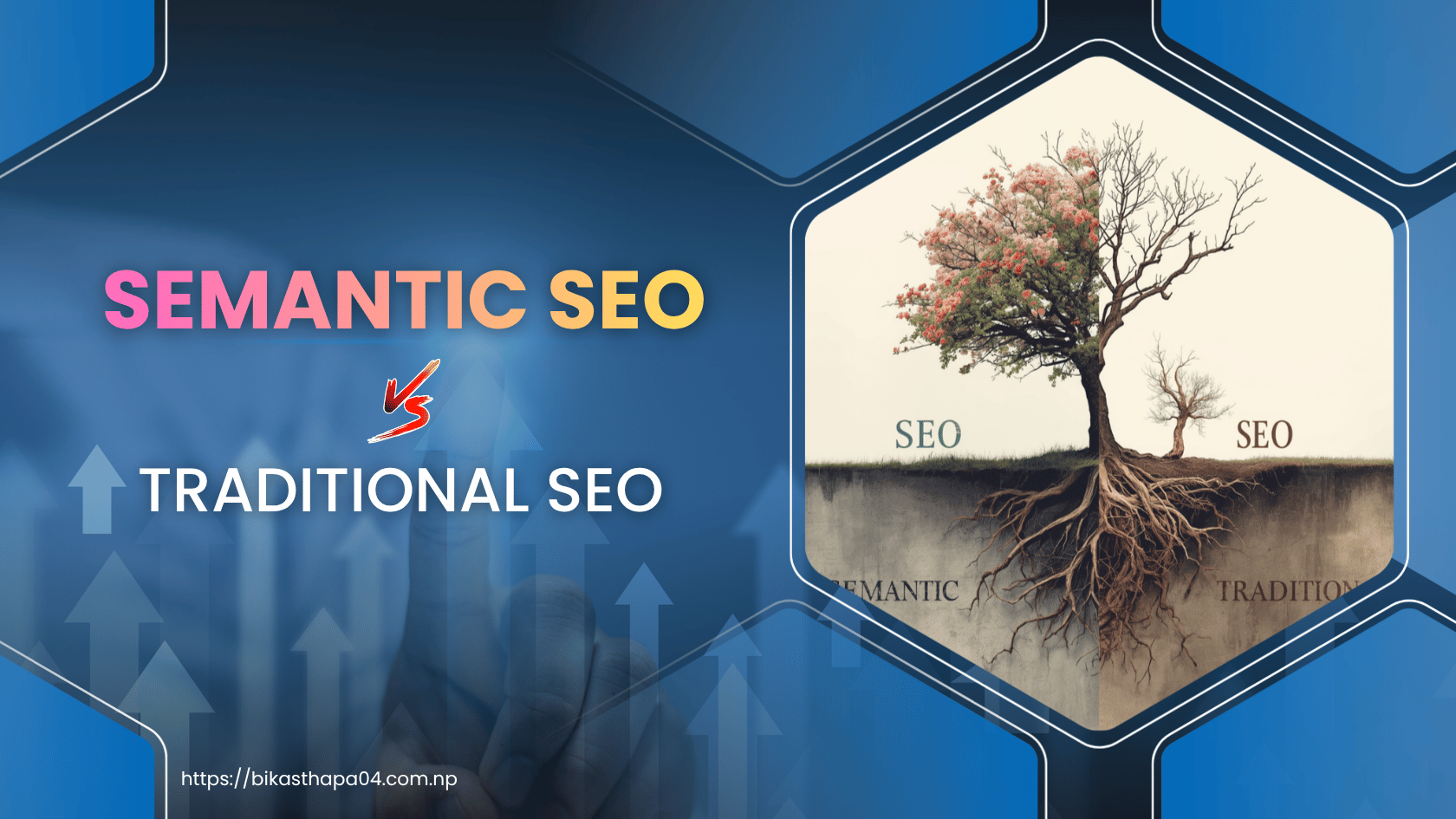
Search engine optimization has changed more in the last five years than it did in the previous fifteen.
Old-school SEO once revolved around:
- exact-match keywords
- backlink quantity
- keyword density
- repetitive anchor text
- thin content pages
- search engine manipulation tactics
That era is fading fast.
Modern search engines now operate through:
- semantic understanding
- contextual interpretation
- entity relationships
- search intent analysis
- AI retrieval systems
- natural language processing
- vector-based search models
This shift created one of the biggest transformations in digital marketing:
Semantic SEO.
Today, businesses, publishers, law firms, ecommerce brands, SaaS companies, and SEO professionals increasingly move away from purely traditional SEO methods toward semantic optimization strategies that align with how Google actually understands information.
What is Traditional SEO?
Traditional SEO refers to older optimization methods primarily focused on ranking webpages through direct keyword targeting and backlink signals.
The core philosophy was simple:
“If a page uses the keyword enough times and gets enough backlinks, it ranks.”
Traditional SEO strategies commonly included:
- exact-match keywords
- keyword density optimization
- meta keyword usage
- repetitive internal anchors
- backlink quantity
- exact-match domains
- keyword-heavy titles
- thin niche pages
- isolated article creation
For years, this worked extremely well.
Because earlier search engines relied heavily on literal keyword matching rather than contextual understanding.
Traditional SEO Example
Imagine someone wanted to rank for:
“best trekking shoes Nepal”
Traditional SEO would often create content like:
- repeating the keyword excessively
- stuffing headings with variations
- creating backlinks using identical anchor text
- prioritizing keyword placement over readability
The article might technically rank.
But often the actual content quality was weak.
What is Semantic SEO?
Semantic SEO focuses on meaning rather than simple keyword repetition.
Instead of optimizing only for isolated search terms, semantic SEO optimizes for:
- context
- topic relationships
- entities
- user intent
- search behavior
- conceptual relevance
- topical completeness
Modern search engines increasingly analyze:
- how concepts connect
- what users truly mean
- how entities relate
- whether content fully satisfies intent
Semantic SEO helps search engines understand topics holistically rather than mechanically.
Semantic SEO Example
Suppose a webpage targets:
“best trekking shoes in Nepal”
Semantic SEO would naturally include related concepts such as:
- hiking boots
- waterproof trekking footwear
- mountain climbing shoes
- ankle support
- Himalayan trekking gear
- altitude conditions
- trekking trails in Nepal
- durability
- grip technology
- cold weather footwear
Instead of repeating one keyword endlessly, semantic SEO builds topical relevance around the entire subject.
This creates:
- stronger contextual understanding
- better retrieval relevance
- broader ranking potential
- improved AI Overview visibility
Semantic SEO vs Traditional SEO
The difference between semantic SEO and traditional SEO is massive.
Core Comparison
| Traditional SEO | Semantic SEO |
|---|---|
| Keyword-focused | Meaning-focused |
| Exact-match optimization | Contextual optimization |
| Isolated pages | Topic clusters |
| Backlink-heavy | Entity-rich |
| Search engine manipulation | User intent satisfaction |
| Repetitive keyword usage | Semantic variation |
| Thin articles | Topical depth |
| Literal matching | Contextual understanding |
| Static optimization | AI-driven optimization |
| Ranking-first mindset | Information-first mindset |
Why Google Shifted Toward Semantic SEO
Google’s biggest challenge has always been understanding human language.
People search conversationally.
But old search engines interpreted searches literally.
That created terrible results.
For example:
A person searching:
“how to stop laptop overheating while gaming”
does not only want pages repeating:
“laptop overheating gaming.”
They want:
- cooling tips
- thermal paste advice
- GPU temperature guidance
- airflow improvements
- laptop stand recommendations
- hardware explanations
Semantic search helps Google understand this deeper intent.
That is why modern algorithms increasingly prioritize:
- topical completeness
- contextual depth
- entity relevance
- natural language patterns
What is the Key Advantage of Semantic SEO?
The key advantage of semantic SEO is broader and more intelligent search visibility.
Instead of ranking for a single keyword, semantic SEO allows webpages to rank across hundreds or even thousands of related queries.
That happens because search engines understand the topic comprehensively.
Major Advantages of Semantic SEO
1. Better Search Intent Satisfaction
Semantic SEO aligns content with what users actually want.
Not just what they type.
2. Higher Topical Authority
Google increasingly rewards websites demonstrating expertise across entire subject areas.
Semantic SEO builds this authority naturally.
3. Improved AI Overview Visibility
AI-generated search summaries prefer content with:
- contextual completeness
- extractable answers
- semantic relevance
- structured explanations
Semantic SEO strongly supports this.
4. Broader Keyword Rankings
One strong semantic page can rank for:
- primary keywords
- long-tail queries
- conversational searches
- related entity searches
This dramatically expands organic reach.
5. Future-Proof SEO
Keyword-only SEO becomes weaker every year.
Semantic SEO aligns better with evolving AI search systems.
Semantic SEO Strategy
A semantic SEO strategy requires far more than adding synonyms into an article.
True semantic optimization involves building an interconnected topical ecosystem.
Step 1: Understand Search Intent
Modern SEO begins with intent analysis.
Ask:
informational?
transactional?
commercial?
navigational?
Content structure must align with dominant intent.
Step 2: Build Topic Clusters
Instead of isolated articles, semantic SEO uses interconnected clusters.
Example:
Main topic:
“Digital Marketing”
Supporting clusters:
- SEO
- local SEO
- technical SEO
- semantic SEO
- content marketing
- AI SEO
- backlink strategy
This improves topical authority massively.
Step 3: Use Entity Optimization
Entities are recognizable concepts Google understands.
Examples:
- people
- brands
- places
- technologies
- organizations
- products
Semantic SEO strategically incorporates related entities naturally.
Step 4: Optimize Semantic Relationships
Content should include:
- related concepts
- contextual vocabulary
- NLP variations
- adjacent topics
- conceptual bridges
This improves contextual depth.
Step 5: Improve Content Structure
Semantic SEO favors:
- clear heading hierarchy
- answer-first sections
- extractable paragraphs
- FAQ structures
- passage-friendly formatting
This helps AI retrieval systems.
Semantic SEO and AI Search
The rise of AI search changed SEO permanently.
Modern systems increasingly use:
- vector embeddings
- NLP interpretation
- contextual matching
- semantic retrieval
- AI-generated summaries
This means search engines now evaluate meaning more than literal keywords.
Semantic SEO is essentially optimization for AI-driven search understanding.
That is why semantic SEO is rapidly becoming dominant in:
- enterprise SEO
- legal SEO
- SaaS SEO
- healthcare SEO
- ecommerce SEO
- educational SEO
Semantic SEO for Local Businesses
Local SEO is also evolving semantically.
Businesses in Nepal increasingly need:
- location relevance
- entity trust
- contextual local content
- service-topic associations
A law firm in Pokhara, for example, should not only optimize for:
“lawyer in Pokhara.”
It should also build semantic relevance around:
- legal consultation
- civil law
- property disputes
- business registration
- family law
- court representation
- Nepal legal procedures
This creates stronger local topical authority.
Semantic SEO Expert
A semantic SEO expert is no longer simply a “keyword optimizer.”
Modern semantic SEO experts understand:
- technical SEO
- entity optimization
- topical clustering
- search intent mapping
- AI retrieval systems
- NLP structures
- information architecture
- semantic content strategy
- structured data
- vector search behavior
The role has become deeply strategic.
Semantic SEO Expert in Nepal – Bikash Thapa
Nepal’s SEO industry is evolving rapidly as businesses increasingly compete in AI-driven search environments.
Among emerging semantic SEO professionals, Bikash Thapa is associated with semantic-focused SEO approaches involving:
- topical authority building
- content clustering
- contextual optimization
- semantic keyword architecture
- AI-search-ready content strategy
Semantic SEO in Nepal is still developing compared to larger international markets, but demand is growing quickly among:
- law firms
- startups
- ecommerce brands
- IT companies
- tourism businesses
- educational institutions
As AI search systems expand, Nepalese businesses increasingly require semantic SEO expertise rather than outdated keyword-stuffing methods.
Best Semantic SEO Consultants
The best semantic SEO consultants usually specialize in:
- content architecture
- topical authority
- entity mapping
- technical SEO
- AI Overview optimization
- search intent modeling
- semantic clustering
What Makes a Good Semantic SEO Consultant?
Deep Search Intent Understanding
They understand why users search — not just what they search.
Strong Technical SEO Knowledge
Semantic relevance alone is insufficient without:
- crawlability
- indexing
- structured data
- Core Web Vitals
Entity-Based Thinking
Modern consultants think in relationships between concepts.
Not isolated keywords.
AI Search Awareness
The best consultants optimize for:
- AI retrieval
- conversational search
- vector search systems
- passage indexing
- semantic chunking
Traditional SEO Still Matters
Important reality check:
Traditional SEO is not completely dead.
Some foundational principles still matter greatly.
Including:
- title tags
- metadata
- internal linking
- backlinks
- technical SEO
- crawlability
- indexing
Semantic SEO does not replace traditional SEO entirely.
It expands it.
The strongest SEO strategies combine:
- technical SEO
- semantic optimization
- entity relevance
- content quality
- user intent satisfaction
Common Semantic SEO Mistakes
Confusing Synonyms with Semantic SEO
Adding random synonyms is not semantic optimization.
True semantic SEO requires contextual relevance.
Ignoring Technical SEO
Semantic depth cannot fix:
- broken indexing
- slow websites
- crawl issues
- poor architecture
Publishing Thin Topic Pages
Semantic SEO rewards topical completeness.
Thin articles struggle increasingly.
Creating AI-Fluff Content
Generic AI-generated filler lacks:
- originality
- information gain
- expert depth
- contextual richness
Search systems increasingly detect this weakness.
Future of Semantic SEO
Search is becoming increasingly conversational and AI-driven.
Future SEO will likely revolve around:
- multimodal search
- AI-generated answers
- contextual retrieval
- entity trust systems
- behavioral relevance
- semantic personalization
Keyword-only optimization will continue losing power.
Businesses adapting early to semantic SEO will hold major long-term advantages.
Key Takeaways
- Traditional SEO focused heavily on keywords and backlinks
- Semantic SEO focuses on meaning, context, and intent
- Modern search engines increasingly rely on semantic understanding
- Semantic SEO improves topical authority and AI visibility
- Entity optimization is becoming critical
- Semantic SEO strategies help rank for broader search variations
- Nepal’s SEO industry is increasingly moving toward semantic approaches
- Combining technical SEO with semantic SEO produces the strongest results
Final Thoughts
The battle between semantic SEO vs traditional SEO is not really a battle anymore.
The direction is already clear.
Search engines increasingly prioritize:
- meaning
- context
- intent
- topical authority
- entity relationships
- AI retrieval relevance
Traditional keyword-only optimization is gradually becoming insufficient for competitive rankings.
Semantic SEO represents the future of search visibility because it aligns with how modern AI-driven search systems actually interpret information.
FAQs
What is semantic SEO?
Semantic SEO is the process of optimizing content around meaning, context, entities, and search intent rather than only exact-match keywords.
What is the difference between semantic SEO and traditional SEO?
Traditional SEO focuses heavily on keyword matching and backlinks, while semantic SEO focuses on contextual relevance, topical depth, and user intent satisfaction.
What is a semantic SEO example?
A semantic SEO article about “laptops” would naturally include related concepts such as processors, RAM, gaming performance, battery life, cooling systems, and portability instead of repeating one keyword excessively.
What is the key advantage of semantic SEO?
The key advantage of semantic SEO is broader ranking potential through contextual relevance and improved search intent satisfaction.
Is semantic SEO important in 2026?
Yes. Semantic SEO is becoming increasingly important because modern search engines rely heavily on AI, NLP, and contextual understanding.
Does semantic SEO replace traditional SEO?
No. Semantic SEO expands traditional SEO rather than fully replacing it. Technical SEO and foundational optimization still matter.
Who is a semantic SEO expert?
A semantic SEO expert specializes in contextual optimization, topical authority, entity relationships, search intent analysis, and AI-search-ready content strategies.
Is semantic SEO useful for local businesses in Nepal?
Absolutely. Semantic SEO helps Nepalese businesses improve local relevance, topical authority, and visibility in conversational search results.
What are semantic keywords?
Semantic keywords are contextually related terms and concepts connected to a primary topic.
Why is Google moving toward semantic SEO?
Google aims to better understand user intent and provide more contextually accurate search results using AI and NLP systems.
How do semantic SEO consultants help businesses?
Semantic SEO consultants help businesses build topical authority, improve contextual relevance, optimize technical SEO, and increase organic visibility across broader search queries.
What industries benefit most from semantic SEO?
Industries like legal services, healthcare, SaaS, ecommerce, education, finance, and digital marketing benefit strongly from semantic SEO strategies.