
One poorly edited video can quietly damage your brand’s credibility more than no video at all. Hiring the wrong video editor, someone who doesn’t understand pacing, platform behavior, or your audience’s attention span, will cost you more than their invoice. In 2025, with short-form content driving real lead generation and brand awareness, choosing the right person to handle your video work is a genuine business decision, not a creative afterthought.
Most business owners evaluate video candidates on vibes: “it looks nice” or “they seem professional.” That surface-level filter is exactly where the wrong hire happens. This guide gives you a sharper framework, one that evaluates the skills that actually convert, the portfolio signals that matter, and the pricing structures worth understanding before you negotiate.
The skills that actually matter in a professional video editor
Technical fluency vs. storytelling instinct
Knowing video editing software like Premiere Pro, DaVinci Resolve, or CapCut is a baseline requirement, not a differentiator. Every candidate you interview will list these tools. What separates a good editor from a forgettable one is their understanding of pacing, audience attention, and visual storytelling. A skilled video editor knows when to cut, not just how to cut. For a quick reference on core editorial competencies, see a summary of the top skills needed for a successful video editing career.
Ask candidates to explain a specific editing decision from their portfolio: why they chose a particular transition, how they structured the opening five seconds, or why a piece runs at its current length. The answers reveal whether they think in terms of viewer psychology or just technical execution. Editors who lead with storytelling instincts consistently outperform those who lead with software proficiency.
Platform-specific knowledge is non-negotiable
A video editor who produces clean YouTube content may have no instinct for the tight framing and rapid hooks that Instagram Reels demand. LinkedIn ads require a completely different rhythm than TikTok clips. These aren’t just format differences. They reflect different audience behaviors, attention windows, and engagement mechanics, and an editor who ignores that distinction will cost you engagement regardless of production quality.
When evaluating candidates, ask directly: what platforms have you produced for, and do you have engagement data from any of those projects? Editors who follow platform best practices, covering aspect ratios, caption placement, and hook structuring, bring measurably more value than generalists who treat all video formats the same.
How to evaluate a portfolio before you hire
What to look for beyond visual polish
A clean color grade and smooth transitions are easy to produce with templates. When you review a portfolio, focus on narrative clarity: does each video make a point quickly? Does it hold attention past the first five seconds? Look for consistency in quality across multiple projects, not just one standout showcase piece that masks the rest of the reel.
Pay close attention to how the editor handles the opening sequence. Videos reliably lose most viewers in the first few seconds, an editor who knows this will structure an opener that earns the next thirty. One who doesn’t will open with a logo animation.
Ask for niche-relevant samples
A strong reel for music content does not predict success with product explainers or customer testimonials. These formats require different structural instincts and different editing rhythms. Ask specifically for examples closest to what you need, whether that’s social media ads, website hero videos, or corporate brand films.
If they don’t have directly relevant samples, that’s useful information too. Consider requesting a small paid test project before committing to a full contract. This protects both sides and filters out editors who look better on paper than they perform in practice. A professional with real confidence in their work will welcome the opportunity.
Freelance video editing pricing: what to expect in 2025
Per-project vs. retainer pricing models
Most freelance video editors charge either per finished minute of content, per project scope, or on a monthly retainer for ongoing work. Per-project pricing works well for one-off campaigns or launch videos, while retainers suit businesses publishing content on a consistent weekly or biweekly schedule. Observed market rates for mid-level editors run between $45 and $65 per hour, with entry-level work starting around $10 to $45 and senior editors reaching $85 to $150 or more. Some platforms, including Upwork’s rate index, reflect similar ranges across regions.
For project-based pricing, short-form social clips (30 to 60 seconds) typically run $50 to $400. A standard YouTube video (5 to 12 minutes) ranges from $150 to $1,500 depending on complexity. Corporate or commercial content runs $500 to $2,000 or more. Monthly retainers for four to eight videos per month generally fall between $1,500 and $4,000. Many editors now also offer packages that include basic motion graphics or subtitle work, which is worth clarifying upfront, especially if you’re using a web-based video editor or mobile video editor for quick-turnaround content alongside a primary editor for longer productions. If you want a market snapshot of typical fees, this breakdown of freelance video editing rates is a useful benchmark.
Offshore rates vs. domestic rates
Hiring a video editor based in South or Southeast Asia often costs 40 to 60 percent less than a comparable US-based editor, with no meaningful drop in output quality when you vet correctly. The geography is irrelevant if the communication is clear and the deliverables are well-defined. What matters more than location is the revision policy, turnaround window, and file delivery process.
Always clarify the number of revision rounds included, the format of final deliveries, and the turnaround timeline in writing before work begins. This one step eliminates the majority of freelance disputes before they have a chance to start.
Freelancer vs. agency: which works better for your business
Where freelancers consistently win
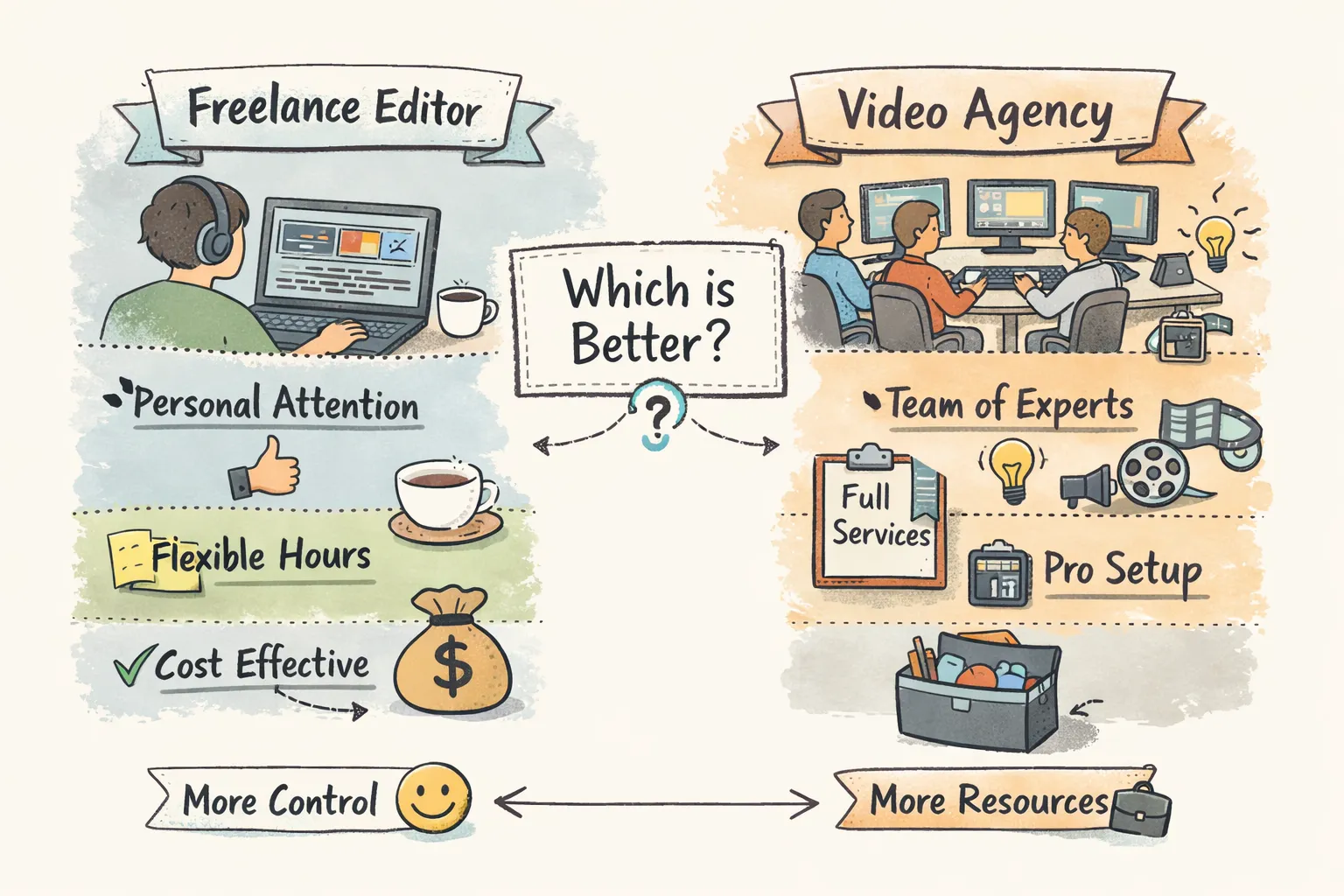
For small businesses and startups, freelance video editors offer faster turnaround, direct communication, and flexible pricing that agencies cannot match at the same budget. You’re working directly with the person doing the work, which shortens feedback loops and makes creative direction far easier to maintain. Agencies introduce account managers, creative briefs, and multi-layer approval chains that add time and cost without adding proportional value for lower-volume clients.
If your business needs two to four videos per month for social media, a product launch, or an ongoing content series, a skilled freelance video editor covers everything required at a fraction of what an agency charges. The direct working relationship also means your brand voice develops faster, there’s no translation layer between you and the person making creative decisions.
When agencies make more sense
If your project requires a full production team working simultaneously, dedicated cinematographers, motion graphics specialists, and sound engineers, an agency structure makes sense. High-budget brand films, broadcast commercials, or large-scale corporate productions benefit from the coordinated infrastructure agencies provide. But for the vast majority of businesses producing digital-first content, that level of infrastructure is overkill. For a comparison of hiring models, see perspectives on in-house vs freelance vs agency video editors.
The key is being honest about your scope before you choose a hiring path. An agency quote for work a skilled freelancer could deliver in three days at a third of the cost is not a better option because the agency has a nicer website.
The case for hiring a freelancer who does more than just video
Video doesn’t work in isolation from your broader digital presence
A professionally edited video placed on a slow website with no SEO strategy behind it will underperform regardless of its production quality. Many business owners treat video editing as a standalone task, then wonder why their investment isn’t generating results. Video is one input in a broader content and visibility system. When it’s disconnected from that system, the return drops significantly.
This is especially relevant for small businesses. You’re not just publishing content, you’re building a digital presence where video, web performance, and search visibility all reinforce each other. An editor who understands only the timeline, and nothing about how that content will be discovered or experienced on your site, is solving half the problem. Even the best free video editor or AI video editor can’t compensate for a weak distribution strategy behind the content.
One-stop freelancers offer more value per dollar
Some freelancers go well beyond editing clips, and that’s worth paying attention to. One example from the South Asia freelance market is Bikash Thapa, a Nepal-based digital services freelancer whose work spans video editing, SEO, web development, and design. For clients who want to manage their entire digital presence through one trusted contact, rather than coordinating across multiple vendors, that kind of integrated offer has a practical advantage.
For small businesses trying to reduce overhead and stretch a limited digital budget, this full-service approach removes the coordination cost that comes with managing separate specialists who don’t communicate with each other. If you’re building or refreshing your brand in 2025, a freelancer who connects your video work to your broader SEO and web strategy will generate stronger returns than one who only handles the edit.
Where to find and vet a freelance video editor worth hiring
Platforms that deliver reliable candidates
Upwork, Fiverr Pro, and LinkedIn are the most consistent platforms for finding experienced video editors with verifiable work histories. Upwork’s job success scores and long-term client history give you a reliable filter before you send a single message. Fiverr Pro vets its top-tier sellers, which reduces the risk of poor-quality work on first engagement. For more specialized or ongoing hires, LinkedIn outreach to editors with branded content portfolios often yields stronger candidates than either platform. You can also hire video editors on Behance to browse curated portfolios from creatives who already position their work publicly.
When browsing any platform, prioritize editors with reviews that mention specific project types similar to yours. Generic five-star reviews mean less than detailed feedback describing how an editor handled revisions, met deadlines, or adapted to brand guidelines. That level of specificity signals a real working relationship, not a templated review.
Questions to ask before you commit
Before hiring any video editor, ask how they handle revision requests, what software they use and why, and whether they have direct experience with your specific content type. Ask for a walkthrough of their workflow: how they receive raw footage, how they communicate progress updates, and how they deliver final files. The answers reveal professionalism faster than any portfolio piece.
- How many revision rounds are included in your standard rate?
- What’s your turnaround time for a three-minute branded video?
- Can you share examples of work that performed well on the platform I’m targeting?
- How do you handle client feedback that changes the creative direction mid-project?
Clear, specific answers to these questions signal a reliable working relationship. Vague answers, or defensiveness about process questions, are red flags worth taking seriously before you hand over a deposit.
Making the right call
The best freelance video editor for your business is one who understands your goals, not just the timeline. Evaluate skills beyond software proficiency. Scrutinize portfolios for platform relevance and storytelling clarity, not just visual polish. Understand pricing models before you negotiate, and be honest about whether a freelancer or agency structure genuinely fits your output needs and budget.
Businesses that invest in the right video editor, and integrate that work into a broader digital strategy covering SEO, site performance, and content distribution, consistently see stronger returns than those treating video as a standalone line item. The edit is only as valuable as the ecosystem it lives in.
If you want to simplify that process, consider working with a digital freelancer who bundles video editing with SEO and web services. You’ll spend less time managing vendors, less energy re-briefing disconnected specialists, and more time reviewing results that actually move the needle for your business.
FAQs
What is better, a freelance video editor or an agency?
Freelancers are better for small projects and budget-friendly work, while agencies are ideal for large, complex projects requiring a team and consistent quality.
How much does a freelance video editor cost in Nepal?
Costs range from NPR 1,000 to 30,000 per video depending on complexity, experience, and project requirements.
Where can I find a freelance video editor in Nepal online?
You can find editors on platforms like Upwork, Fiverr, Facebook groups, and LinkedIn.
What is the salary of a freelance video editor in Nepal?
Salaries range from NPR 15,000 to 200,000+ per month depending on experience and client base.
How do I choose a video editor in Kathmandu?
Evaluate their portfolio, experience, communication skills, and client reviews before hiring.
Can freelancers deliver professional quality?
Yes, experienced freelancers can deliver high-quality work comparable to agencies.
How long does video editing take?
It depends on complexity but usually takes 1–5 days for standard projects.
Is it better to hire locally or online?
Local hiring offers better communication, while online hiring provides more options and competitive pricing.
What skills are needed to become a freelance video editor?
Editing software skills, storytelling ability, creativity, and time management are essential.
Can I earn a full-time income as a freelance video editor?
Yes, many freelancers in Nepal earn a stable full-time income, especially with international clients.
Do agencies guarantee better results?
Agencies provide consistency and team support, but skilled freelancers can match or exceed quality.